
 Ahmed valve price in Turkey
 How the surgery is done
 Ahmed vs Baerveldt and trabeculectomy
 Risks and complications
 Eye clinics in Turkey
- At the clinic’s price without markups
- with full doctor support
The Ahmed glaucoma valve price in Turkey on our site is €6,000 for implantation in one eye at Dünyagöz Samsun. Dünyagöz in Istanbul lists glaucoma surgery at $2,740 to $6,020. We checked these prices on November 19, 2026. The final figure depends on the eye, the valve model and the tests the surgeon needs.
Ahmed glaucoma valve surgery price in Turkey
Turkish eye clinics publish these glaucoma prices on our site. Besides the valve, they list trabeculectomy, an operation that makes a new drainage opening in the wall of the eye. All prices are for one eye and cover the clinic only, without travel.
| Clinic | Procedure | Price on experts-medical.com, November 19, 2026 |
|---|---|---|
| Dünyagöz Samsun | Ahmed valve implantation | €6,000 |
| Dünyagöz Samsun | Trabeculectomy | €6,000 |
| Dünyagöz Samsun | Comprehensive glaucoma examination | €850 |
| Dünyagöz Eye Clinic, Istanbul | Glaucoma surgery | $2,740 to $6,020 |
| Dünyagöz Eye Clinic, Istanbul | Visual field examination | $70 to $80 |
On our glaucoma treatment in Turkey page, trabeculectomy starts at $2,500. The Istanbul range is wide because "glaucoma surgery" covers several operations, from trabeculectomy to drainage implants. For a quote for your case, send your recent eye pressure readings and visual field test to our coordinator.
What the price of an Ahmed valve implant includes
Ask the clinic for a written quote and check these items in it:
- the device and its model, for example the silicone FP7 or the polypropylene S2;
- the surgeon's fee, the operating room and the anesthesia;
- the examination before surgery and the follow-up visits after it;
- drops for the first weeks after the operation;
- a patch of donor tissue (patch graft) that covers the tube and protects it.
The price is for one eye. If both eyes need a valve, each eye is priced separately. Ask the surgeon whether both eyes can be treated in one trip. Flights, hotel and the extra days for check-ups are not part of the clinic price, and we help you count them before you decide.
What an Ahmed valve implant is
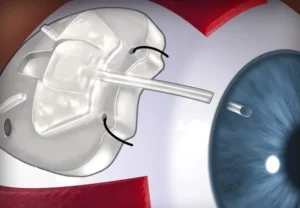
An Ahmed valve implant is a glaucoma drainage device made by New World Medical in the USA (U.S. Food and Drug Administration record). It has a thin flexible tube and a small curved plate. The tube goes into the front chamber of the eye, and the plate sits on the white of the eye under the conjunctiva, the clear membrane that covers it.
In glaucoma, fluid inside the eye does not drain well. Intraocular pressure rises and damages the optic nerve. The implant gives the fluid a new way out: it flows through the tube to the plate and is absorbed by the tissue around it.
Unlike non-valved implants, it has a mechanism that restricts flow in the first days after surgery, which makes early eye pressure easier to control (EyeWiki). The plate comes in several models. The FP7 has a silicone plate of 184 mm², the S2 is the same size in polypropylene, and the FP8 and S3 are pediatric versions of 96 mm².
Who needs Ahmed valve implantation
A drainage implant is recommended when eye drops and laser have not lowered eye pressure enough (American Academy of Ophthalmology). So Ahmed valve implantation is not the first step in treatment. Surgeons usually choose it in these cases (EyeWiki):
- severe glaucoma that stays uncontrolled after earlier glaucoma surgery;
- glaucoma caused by abnormal new blood vessels in the eye (neovascular) or by inflammation inside it (uveitic), where trabeculectomy is more likely to fail;
- congenital and childhood glaucoma;
- glaucoma after an eye injury, cataract surgery or a corneal transplant;
- high pressure after retinal surgery with silicone oil.
When another operation may suit you better
There is no single list that rules a patient out. The surgeon looks at the conjunctiva, because heavy scarring limits where the plate can go. A very low target pressure is another factor: in the Ahmed Baerveldt Comparison (ABC) study, pressure after five years was lower with the Baerveldt implant. Early glaucoma that responds to drops or laser usually does not need a drainage device at all. The ophthalmologist decides after an examination, and we pass on the reasons in writing.
How Ahmed valve surgery is done

The operation usually takes about an hour or less and is done in a hospital or an outpatient surgery center (American Academy of Ophthalmology). You get local anesthesia around the eye and medicine to help you relax. The steps of Ahmed valve insertion are:
- The surgeon opens the conjunctiva, most often in the upper outer part of the eye.
- The plate is placed on the sclera and fixed with stitches.
- The tube is cut to length and inserted into the front chamber of the eye.
- The tube is covered with a patch graft, and the conjunctiva is closed.
The fluid then collects over the plate in a small reservoir, called a bleb, and is absorbed. A capsule of tissue forms around the plate in about 4 to 6 weeks and regulates the flow (EyeWiki).
Ahmed valve vs Baerveldt implant and trabeculectomy
Two large randomized studies help compare the options. The ABC study followed the Ahmed FP7 and the Baerveldt implant for five years (outcomes, 2015; complications, 2016).
| Result in the ABC study | Ahmed valve FP7 | Baerveldt implant |
|---|---|---|
| Valve that limits early flow | Yes | No, the tube is tied off for the first weeks |
| Failure after 5 years | 44.7% | 39.4% |
| Mean eye pressure after 5 years | 14.7 mmHg | 12.7 mmHg |
| Repeat glaucoma surgery in 5 years | 20.8% | 8.6% |
| Serious complications in 5 years | 15.9% | 24.7% |
The difference in failure was not statistically significant (p = 0.65), so both implants worked about equally well overall. The Baerveldt implant gave lower pressure and fewer repeat operations. The Ahmed FP7 had fewer serious complications, mostly because its tube was blocked less often.
The Tube Versus Trabeculectomy (TVT) study compared a Baerveldt tube with trabeculectomy in eyes that had earlier eye surgery. Valved implants were not part of it. Its results show how tube surgery compares with trabeculectomy, not how this valve performs. After five years, the tube failed in 29.8% of eyes and trabeculectomy in 46.9%. Repeat glaucoma surgery was needed in 9% and 29% of eyes, while pressure ended up similar, 14.4 and 12.6 mmHg. Early complications were more frequent after trabeculectomy, 37% against 21%, and late ones were about equal (TVT complications, 2012).
The choice depends on your type of glaucoma, the target pressure and past surgery.
Not sure which operation suits your eye? Send us your eye records or call +90 554 498 51 53 (Turkey).
Risks and complications of an Ahmed valve implant
Any glaucoma operation can cause complications, and some appear months or years later. These are the possible ones (American Academy of Ophthalmology, EyeWiki):
- A hypertensive phase between the first and sixth week, when pressure rises to 30 to 50 mmHg while the capsule forms. It is more common with valved implants. Doctors treat it with drops, eye massage or needling (the surgeon loosens the scar tissue over the plate with a fine needle).
- Too low intraocular pressure (hypotony). It is less common with valved devices, but it can lead to fluid or bleeding in the choroid, the layer of blood vessels under the retina.
- Tube problems. The tube can get blocked, move or wear through the conjunctiva. In the ABC study, tube erosion occurred in 1% of Ahmed eyes and 3% of Baerveldt eyes.
- Swelling of the cornea when the tube sits too close to it. In the ABC study, about 12% of eyes had persistent corneal swelling linked to the implant.
- Double vision, because the plate and bleb can press on eye muscles. In the ABC study, about 12% of patients in both groups had persistent double vision.
- Infection and bleeding inside the eye. Infection can occur even years after surgery, so a red or painful eye needs a doctor the same day.
The valve does not bring back vision that glaucoma has already taken. Its job is to protect the optic nerve from further damage. In the ABC study, about one in five patients with the Ahmed valve needed another glaucoma operation within five years.
Recovery and follow-up after Ahmed valve surgery
The first check is on the day after surgery and the next one about a week later (EyeWiki). Antibiotic and steroid drops are used for 4 to 6 weeks. Vision may be blurry for several days to a few weeks, and you should not bend over, strain or lift heavy objects while you recover (American Academy of Ophthalmology).
Many Ahmed valve implant glaucoma patients still use drops. In the ABC study, they needed about two glaucoma medications on average after five years. Your doctor decides which drops to keep.
Before you fly home, ask the clinic for a discharge summary in English for your local ophthalmologist, so the check-ups continue without a gap. Our coordinator helps you get it.
Turkish eye clinics and ophthalmologists for glaucoma surgery

These clinics and doctors are on our site and list glaucoma surgery among their services.
- Dünyagöz Eye Clinic, Istanbul. A network of eye hospitals accredited by Joint Commission International. Prof. Yavuz Kamil Bardak treats glaucoma surgically, and Dr. Haluk Talu lists glaucoma surgery among his specialties.
- Dünyagöz Samsun. Its Ahmed valve implantation price is in the table above.
- Dünyagöz Ankara-Tunus. Professor Atilla Bayer treats glaucoma there. He received an award from the American Academy of Ophthalmology in 2008.
- Dr. Hakan Sivrikaya, Antalya, Dünyagöz. He treats cataracts and glaucoma.
- Veni Vidi Eye, Istanbul. The clinic treats glaucoma with surgery, including shunts that lower intraocular pressure.
More doctors are listed on the page ophthalmologists in Turkey.
How we organize Ahmed valve surgery in Turkey

A request for glaucoma surgery starts with your records. Send us your recent intraocular pressure readings, the visual field test, an optical coherence tomography scan of the optic nerve and the list of drops you use. If you have had eye surgery before, add the reports.
We send the records to the surgeons you choose and return their opinions with a written quote. Sometimes the surgeon suggests laser or a different operation instead of a valve, and we tell you. Our coordinator then plans the dates, the transfer and an interpreter at the clinic. Our services are free for patients.
Send your eye records for a free assessment or call +90 554 498 51 53 (Turkey) or +44 74 41 47 67 14 (UK).
FAQ
Will the Ahmed valve be visible?
Usually not in everyday life. The plate is most often placed in the upper outer part of the eye, where the upper eyelid mostly covers it. The tube lies under a patch and the conjunctiva. An eye doctor sees it during an examination.
How many days do I need to stay in Turkey?
Plan to stay at least until the check-up about a week after surgery. The surgeon may ask you to stay longer if the pressure is unstable. We agree the dates with the clinic before you book flights.
Can I fly after Ahmed valve surgery?
This operation does not put a gas bubble in the eye, unlike some retinal surgery. The surgeon sets the date of your flight home after the check-up.
What is the Ahmed glaucoma valve FP7 price?
No clinic page on our site lists the Ahmed glaucoma valve FP7 price separately. Ask which model is in your quote and what else the quote includes. The FP7 has a silicone plate, and the S2 is the polypropylene version.
How long does an Ahmed valve implant last?
The device stays in the eye permanently, but its effect can weaken as tissue around the plate scars. In the ABC study, 44.7% of eyes with the FP7 met the failure criteria within five years. These were pressure that stayed too high or too low, repeat glaucoma surgery or loss of light perception.
Does an Ahmed valve for glaucoma cure the disease?
No. It lowers the pressure and slows further damage, but lost vision does not come back. You need regular pressure checks for life.
Sources
- American Academy of Ophthalmology: What Is a Glaucoma Drainage Implant?
- EyeWiki, American Academy of Ophthalmology: Glaucoma Drainage Devices
- Budenz DL et al., Ophthalmology, 2015: Five-year treatment outcomes in the Ahmed Baerveldt Comparison Study
- Budenz DL et al., American Journal of Ophthalmology, 2016: Postoperative complications in the Ahmed Baerveldt Comparison Study during five years of follow-up
- Gedde SJ et al., American Journal of Ophthalmology, 2012: Treatment outcomes in the Tube Versus Trabeculectomy (TVT) study after five years of follow-up
- Gedde SJ et al., American Journal of Ophthalmology, 2012: Postoperative complications in the TVT study during five years of follow-up
- U.S. Food and Drug Administration: 510(k) clearance K230975, Ahmed Glaucoma Valve Model FP7