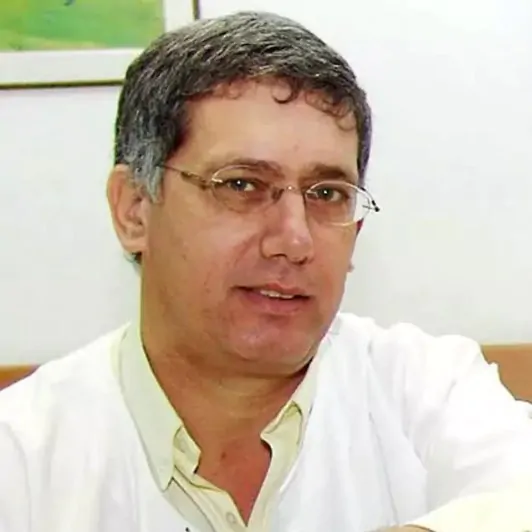


In 2024 Rambam announced that two senior neurointerventional surgeons had joined its Invasive Neuroradiology Unit, also called the brain catheterization unit. The hospital said that Professor Shimon Maimon returned to Rambam to strengthen the team. The unit is directed by Dr. Eytan Abergel. With three senior surgeons, it can keep a specialist available around the clock for patients with stroke. The announcement was republished by American Friends of Rambam.
His most recent paper confirms the move. In a 2026 article in Neuroradiology on venous stenting in a toddler, all four authors, including Shimon Maimon, are listed at Rambam Health Care Campus, Haifa.
From 2010 to 2024, his papers list Tel Aviv Sourasky Medical Center (Ichilov) as his hospital. Earlier articles name the Department of Neurosurgery and Tel Aviv University. Later ones name the Invasive Neuroradiology Unit and, in a 2024 paper, the Interventional Neuroradiology Unit.
Ichilov describes the work of its neurointerventional unit as diagnosis and minimally invasive treatment of vascular diseases of the brain, head, neck and spine. The list includes clot removal in acute stroke, coils, stents or balloons for brain aneurysms, embolization of malformations and fistulas, stenting of narrowed arteries and diagnostic angiography. His papers from Ichilov cover aneurysms, AVMs and dural fistulas. The hospital itself is described on our page about Tel Aviv Sourasky Medical Center (Ichilov).
His published work and the units he has worked in show the following areas:
Some malformations and aneurysms need an operation or radiosurgery, a precisely focused dose of radiation that closes the abnormal vessels over time. Then the decision is made together with the neurosurgeons. Several of his studies describe exactly this combined approach.
Diagnosis and treatment start the same way. The doctor makes a small cut over an artery, usually near the groin or wrist, passes a thin catheter into it and guides it up to the vessels of the brain under X-ray control. Contrast injected through the catheter shows the vessels on the screen. This picture is called cerebral angiography. When it is done only to make a diagnosis, the patient is usually awake and the skin is numbed with a local anesthetic. The NHS notes that an aneurysm is treated under general anesthesia, both in open surgery and from inside the artery. For other procedures the team chooses the anesthesia.
An aneurysm is a bulge in the wall of an artery. The NHS describes two main ways to treat one: clipping it during open surgery or closing it from inside the artery with coils or a mesh device. A flow diverter is a fine mesh tube placed in the artery. It turns the blood flow away from the aneurysm so that the aneurysm gradually closes. Not every aneurysm needs treatment. The NHS notes that small aneurysms without symptoms are often only followed with regular scans. More about causes and risk factors is on the NINDS page on brain aneurysms.
In an AVM, arteries connect directly to veins through a tangle of abnormal vessels. During embolization the doctor delivers a liquid embolic agent through the catheter and fills these vessels from inside. Prof. Maimon published several studies on embolization of brain AVMs and dural fistulas with Onyx, one such agent. Embolization is sometimes the whole treatment. More often it prepares the AVM for surgery or radiosurgery.
In a stroke caused by a clot in a large artery, the doctor can remove the clot through a catheter. This is called thrombectomy. The NHS lists it among the treatments given in the first 24 hours after a stroke. Because time matters so much, acute stroke is treated in the nearest hospital, not on a planned trip abroad. A consultation with Prof. Maimon makes sense after the acute phase or for narrowed arteries that may cause a stroke later.
Results depend on the size and location of the lesion and on your general health. We do not promise an outcome before the doctor has seen your images.
PubMed lists 19 papers under the full name Shimon Maimon as of November 25, 2026. Among his papers:
He is the first author of the 2011 study on dural fistulas and of the 2016 review. In the 2013 AVM series and the Silk study he is listed as the last author.
Patients and their families thank Dr. Maimon for saving their lives or the lives of their loved ones. One family writes about a very complicated brain stenting, another about treatment of a vein malformation in the neck. We publish the reviews as they were sent and do not edit their content.
| Service | Price, USD |
|---|---|
| Specialist consultation | 200 to 400 |
| Correspondence consultation (review of records) | 370 |
| MRI of the brain | 800 to 1500 |
| CT with contrast | 600 to 1000 |
These prices are taken from our page about Rambam Health Care Campus and are current as of November 25, 2026. They are the hospital’s general ranges, not the personal fee of Prof. Maimon. The price of his consultation and of a procedure is confirmed on request, after your images have been reviewed. Our coordinator sends the exact amount before you book.
The first step is usually a review of your images. An aneurysm or a malformation is assessed on MRI, CT angiography or catheter angiography, and only then does the doctor say whether treatment is needed and which method suits it. To ask for the opinion of Prof. Shimon Maimon, send the images to our coordinator.
The original image files matter most. A specialist needs them to measure the neck of an aneurysm or to see the arteries that feed an AVM. We help with translation of the reports.
Rambam offers a correspondence consultation, a review of records without a visit. If travel is hard, our coordinator can ask whether Prof. Shimon Maimon reviews records this way or by an online call. The format is confirmed when you send the request.
Treatment options in other countries are compared in our guides to brain aneurysm treatment abroad and treatment of arteriovenous malformations. For a second opinion, see the lists of neurosurgeons in Israel and radiologists in Israel. Clinics and programs are collected in the section on neurosurgery treatment abroad.
Prof. Shimon Maimon, interventional neuroradiologist in Israel
Interventional neuroradiologist
Prof. Shimon Maimon is an interventional neuroradiologist. He treats diseases of the blood vessels of the brain, head, neck and spine from inside the vessels, through a thin catheter, without opening the skull. Since 2024 he has worked in the Invasive Neuroradiology Unit of Rambam Health Care Campus in Haifa. For many years before that he worked at Tel Aviv Sourasky Medical Center (Ichilov). If you would like his opinion, send us your diagnosis and images. Our coordinator checks with the doctor whether he can review your case and replies with the options.
Editorial Policy Experts Medical
He works in the Invasive Neuroradiology Unit of Rambam Health Care Campus in Haifa, which he rejoined in 2024. Before that he worked for many years at Tel Aviv Sourasky Medical Center (Ichilov).
Prof. Shimon Maimon is an interventional neuroradiologist. He treats vessels of the brain through a catheter, and at Ichilov his work was part of the Department of Neurosurgery.
Yes, his published work covers closing aneurysms from inside the artery, including with flow diverters. Whether your aneurysm suits this method is decided after a review of your angiography.
Our coordinator can ask him for a review of your records or an online consultation. Rambam offers correspondence consultations, and the format is confirmed after the request.
His fee is confirmed on request. A correspondence consultation at Rambam costs 370 USD and a specialist consultation 200 to 400 USD as of November 25, 2026.
Send MRI or CT angiography files, catheter angiography recordings, radiologist reports, discharge summaries and a list of current medicines, including blood thinners.